
Dr Seuss The Cat in the Hat


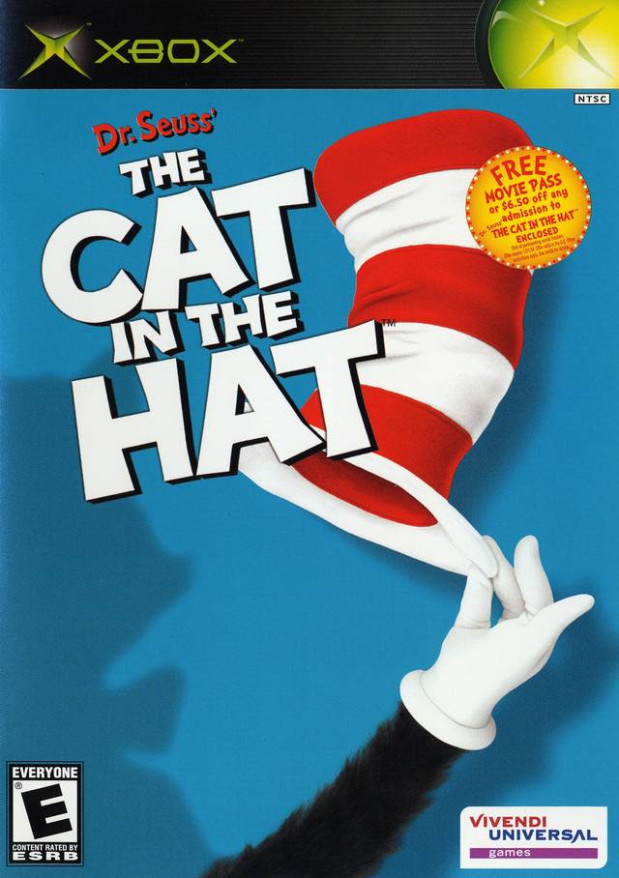
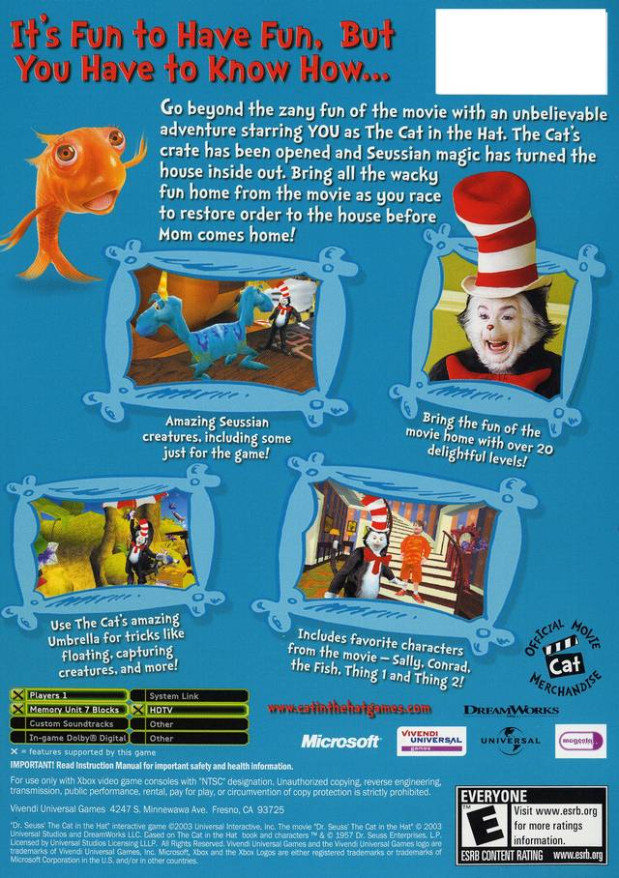




Platform: Microsoft Xbox
Game Type: Released
Max Players: 1
Genre: Platformer
Developers: Magenta Software
Publishers: Vivendi Universal Games
Cooperative: No
PEGI: 3 +
Dr Seuss The Cat in the Hat Game Overview
Dr Seuss' The Cat in the Hat brings the beloved children's book to interactive life through faithful adaptation that captures the whimsical spirit and distinctive visual style of the original illustrations. Players join Conrad and Sally as they explore their transformed home alongside the mischievous Cat in the Hat, who converts ordinary rooms into extraordinary adventure environments filled with magical contraptions and fantastical scenarios. The game features numerous mini games and interactive challenges that reflect the Cat's playful personality whilst incorporating educational elements that support early childhood development in reading, mathematics, and creative problem solving. Each household room undergoes dramatic transformation, from circus arenas and cooking laboratories to dreamscape environments and underground passages that extend beyond architectural boundaries. Character development follows the original story's progression whilst expanding through interactive sequences that demonstrate the importance of imagination, creativity, and responsibility. The adventure maintains family friendly accessibility through simplified controls, clear visual feedback, and forgiving gameplay mechanics that encourage experimentation and exploration without punishing mistakes or requiring advanced gaming skills from younger players.
Dr Seuss The Cat in the Hat
Dr Seuss' The Cat in the Hat transforms the beloved children's literature into an interactive adventure that captures the whimsical spirit and imaginative storytelling of the original book through engaging gameplay mechanics. Players join Conrad and Sally as they navigate through their home alongside the mischievous Cat in the Hat, who brings chaos and wonder to an ordinary rainy day through magical contraptions and fantastical scenarios. The game faithfully recreates the distinctive visual style of Dr Seuss' illustrations through vibrant colours, exaggerated character designs, and impossible architectural structures that defy conventional physics and spatial logic. Interactive elements encourage exploration and experimentation as players discover hidden areas, collect magical items, and participate in mini games that reflect the Cat's playful personality and creative problem solving approaches. The adventure spans multiple rooms within the family home, each transformed into elaborate themed environments filled with Seussian creatures, mechanical gadgets, and surreal landscapes that bring childhood imagination to vivid interactive life. Family friendly gameplay mechanics ensure accessibility for younger players whilst maintaining enough complexity to engage older participants through varied objectives and creative challenges that reward curiosity and persistence throughout the magical household adventure.
Faithful Literary Adaptation and Visual Design
The game's visual presentation meticulously recreates the iconic artistic style of Dr Seuss' original illustrations through bold colour choices, flowing curved lines, and whimsical character proportions that maintain authenticity to the source material. Environmental design captures the essence of Seussian architecture through impossible geometries, spiralling staircases, and rooms that expand beyond logical spatial boundaries to accommodate fantastical gameplay scenarios. Character animations reflect the distinctive movement patterns and exaggerated expressions found in the original artwork whilst translating two dimensional illustrations into three dimensional interactive environments successfully. The Cat in the Hat's distinctive red and white striped hat serves as both visual identifier and interactive gameplay element, housing various magical contraptions and serving as storage for collected items throughout the adventure. Thing One and Thing Two appear as supporting characters whose chaotic energy drives various gameplay sequences and mini game challenges that reflect their mischievous nature from the literary source. Colour palettes emphasise primary colours and bold contrasts that create visually striking environments appealing to young players whilst maintaining the sophisticated artistic sensibility that made the original books enduringly popular. The adaptation successfully translates static illustrations into dynamic interactive spaces that preserve the magical quality of Dr Seuss' imagination whilst providing engaging gameplay experiences for diverse age groups.
Interactive Household Exploration and Room Transformation
Each room within the family home undergoes dramatic transformation as the Cat in the Hat's influence spreads throughout the house, converting ordinary domestic spaces into extraordinary adventure environments filled with interactive elements. The living room becomes a circus arena complete with tightrope walking challenges and acrobatic performances that test player coordination and timing whilst maintaining the playful atmosphere characteristic of Seussian entertainment. The kitchen transforms into an elaborate cooking laboratory where players participate in recipe creation mini games using fantastical ingredients and magical cooking implements that produce surprising and delightful results. Bedroom areas become dreamscape environments where imagination takes physical form through floating platforms, gravity defying furniture arrangements, and interactive toys that come to life under the Cat's magical influence. The basement reveals hidden passages and secret chambers that extend far beyond the house's apparent architectural boundaries, creating underground adventure sequences filled with mysterious creatures and ancient Seussian artefacts. Bathroom facilities become aquatic wonderlands with submarine exploration sequences and underwater puzzle challenges that utilise the Cat's amphibious contraptions and magical breathing apparatus. Garden areas expand into vast outdoor landscapes populated by Seussian flora and fauna that respond to player interaction through musical performances, colour changing displays, and cooperative gameplay elements that encourage environmental stewardship.
Mini Games and Interactive Challenges
The adventure incorporates numerous mini games that reflect different aspects of the Cat's personality and magical abilities whilst providing varied gameplay experiences that maintain engagement throughout the household exploration. Balance based challenges require players to assist the Cat in maintaining equilibrium whilst juggling increasingly complex arrangements of household objects, books, and magical contraptions in physics defying displays. Musical sequences encourage rhythm and timing as players participate in impromptu concerts using the Cat's magical instruments and sound producing devices that create harmonious melodies from everyday household items. Memory games challenge players to recreate increasingly complex patterns and sequences using the Cat's collection of magical tools and colourful accessories whilst racing against time limits. Puzzle solving mini games utilise logical thinking and spatial reasoning as players help the Cat construct elaborate Rube Goldberg style contraptions that accomplish simple household tasks through unnecessarily complex but entertaining mechanical processes. Collection challenges encourage thorough exploration as players search for hidden items, secret passages, and magical objects scattered throughout the transformed household environments by Thing One and Thing Two's chaotic activities. Cooperative sequences require coordination between Conrad and Sally as they work together to assist the Cat in various activities whilst learning valuable lessons about teamwork and creative problem solving approaches.
Educational Content and Learning Integration
The game seamlessly incorporates educational elements that align with early childhood development goals whilst maintaining the entertaining and imaginative qualities that define Dr Seuss' literary work and educational philosophy. Reading comprehension activities emerge naturally from story progression as players encounter text based clues, character dialogue, and environmental descriptions that advance the narrative whilst reinforcing literacy skills. Mathematical concepts appear through counting games, pattern recognition challenges, and spatial reasoning puzzles that utilise the Cat's magical contraptions and household transformation sequences as engaging learning tools. Scientific principles receive playful exploration through the Cat's various experiments and inventions that demonstrate basic physics concepts, cause and effect relationships, and creative problem solving methodologies. Social skills development occurs through character interactions that emphasise cooperation, responsibility, and the importance of cleaning up after creative activities and imaginative play sessions. Colour recognition and artistic appreciation receive reinforcement through the game's vibrant visual design and creative activities that encourage artistic expression and aesthetic awareness amongst young players. Music appreciation emerges through the Cat's various musical performances and interactive rhythm games that introduce basic musical concepts and encourage auditory discrimination skills. The educational integration remains subtle and organic, avoiding heavy handed instructional approaches that might diminish the magical and entertaining qualities of the interactive experience.
Character Development and Narrative Progression
Conrad and Sally serve as the primary protagonists whose initial reluctance to participate in the Cat's chaotic activities gradually transforms into enthusiastic participation as they discover the joy of creative expression and imaginative play. The Cat in the Hat maintains his role as the catalyst for adventure whilst demonstrating character growth through increased awareness of responsibility and the importance of restoring order after creative activities conclude. Character development occurs through environmental storytelling and interactive sequences that reveal personality traits, family dynamics, and the transformative power of imagination in overcoming boredom and routine. The narrative structure follows the original story's progression whilst expanding upon key moments through interactive gameplay that allows players to participate directly in the Cat's magical activities and household transformations. Supporting characters including Thing One and Thing Two contribute to character development through their interactions with the protagonists, demonstrating different approaches to creativity and the importance of channelling chaotic energy constructively. The family pet fish serves as the voice of caution and responsibility, providing counterpoint to the Cat's chaotic influence whilst contributing to discussions about rule following and creative expression. Character relationships evolve throughout the adventure as Conrad and Sally learn to balance imagination with responsibility whilst maintaining respect for their home environment and family expectations.
Technical Implementation and Family Accessibility
The game's technical design prioritises accessibility and ease of use for younger players through simplified control schemes, clear visual feedback, and forgiving gameplay mechanics that encourage experimentation without punishing mistakes. Interface design utilises large buttons, intuitive navigation systems, and visual icons that communicate function clearly without requiring advanced reading skills or complex menu navigation. Loading times remain minimal to maintain attention spans and prevent frustration during gameplay transitions between rooms and mini game sequences throughout the household adventure. Audio design incorporates clear narration, recognisable sound effects, and musical accompaniment that enhances immersion whilst providing audio cues for gameplay mechanics and story progression. The game supports multiple difficulty levels that adapt challenge complexity to individual player abilities whilst maintaining consistent story progression and character development throughout the adventure experience. Save system implementation allows for interrupted play sessions and gradual progression through the adventure whilst accommodating family schedules and attention span limitations common amongst younger players. Technical stability ensures reliable performance during extended play sessions whilst preventing crashes or technical issues that might disrupt the magical atmosphere and immersive storytelling experience. The implementation successfully balances technical sophistication with user friendly design that makes the adventure accessible to diverse age groups and gaming experience levels.
Legacy and Impact
Dr Seuss' The Cat in the Hat established important precedents for literary adaptation in interactive entertainment, demonstrating how beloved children's books could successfully transition to gaming platforms whilst preserving their educational value and artistic integrity. The game's approach to family friendly content influenced subsequent children's games by emphasising creativity, imagination, and positive social values over competitive gameplay and achievement focused mechanics. Its faithful recreation of Dr Seuss' distinctive visual style showed how iconic artistic aesthetics could be successfully translated into three dimensional interactive environments without losing their essential character and appeal. The title's educational integration demonstrated effective methods for combining entertainment with learning objectives in ways that feel natural and engaging rather than forced or overtly instructional. Commercial success validated the market potential for high quality children's gaming content that respected both source material and audience intelligence whilst providing meaningful interactive experiences. The game's emphasis on creativity and imagination influenced subsequent family entertainment software by showing how interactive media could encourage artistic expression and creative thinking amongst young users. Its technical accessibility features established best practices for designing games that accommodate diverse age groups and ability levels whilst maintaining engaging gameplay experiences. Dr Seuss' The Cat in the Hat's contribution to family gaming continues influencing developers creating educational entertainment that combines beloved characters with meaningful interactive experiences that support childhood development and creative expression.


